|
|
|
Attractions
 Roughlock Falls in Spearfish Canyon
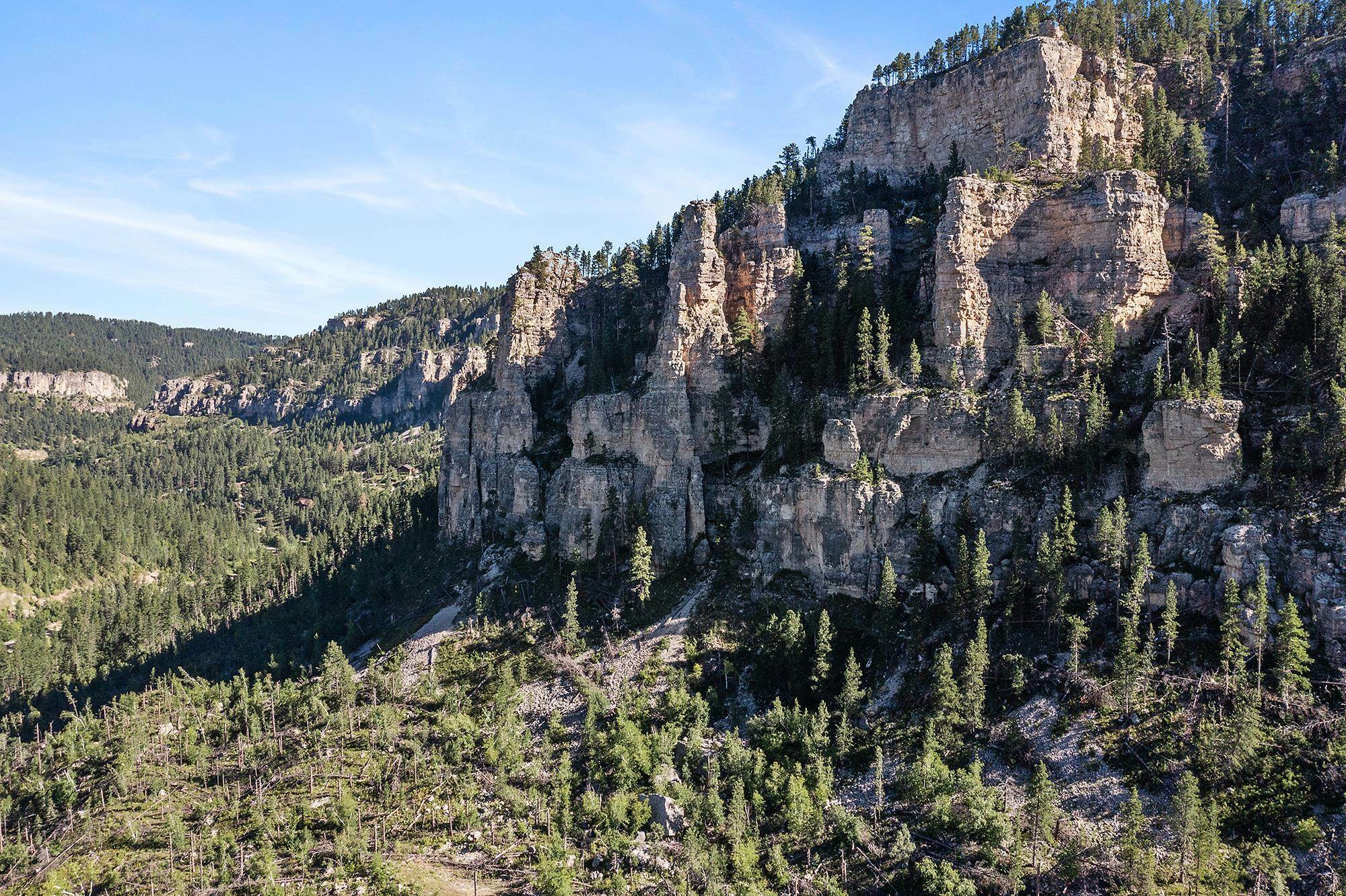
Spearfish Canyon
The breathtaking limestone palisades of this creek-carved gorge are more ancient than the Grand Canyon -- albeit much closer together. The narrow walls of Spearfish Canyon, which rise up to 1,000 feet above the creek bed, are among the most spectacular scenery in the Black Hills. Cascading waterfalls quench the thirst of quaking aspen, gnarled oaks, sweet-smelling spruce and the ubiquitous ponderosa pine, which grow right off the edges of rocky precipices. The diverse array of plant life provides a comfortable home for deer, mountain goats, porcupines and bobcats. The canyon was accessible only by horseback until a railroad line to Deadwood was completed in 1893. When a flood in 1933 all but destroyed the tracks, a motorway was built right on top of the ancient rail bed. Today, this road is U.S. 14A, one of America's few designated scenic byways. The highway continues through the canyon for nearly 20 miles, affording visitors views of both its pristine natural wonders and its historical treasures. Near the end of the canyon is the old sawmill town of Savoy, which provides a jumping off point for several scenic hikes and forays into ancient mining and logging camps. Further up the canyon is Cheyenne Crossing, the point where the gold-rush era Deadwood-Cheyenne stage line crossed Spearfish Creek.
The D.C. Booth Fish Hatchery
Constructed in 1899 as the region's first fish management center, the Spearfish National Fish Hatcherywas responsible not only for introducing trout to the Black Hills, but for being the first to control the fish population in Yellowstone National Park. The institution quickly grew in importance, becoming the coordination center for all federal fisheries in the Western United States. But by the 1980s budget cuts forced the Fish and Wildlife Service to close the hatchery. Renamed for its first superintendent, its colorful history, pristine setting and century-old buildings are now preserved as an educational center devoted to fish culture. Besides the original ponds, hatchery structure, icehouse and Victorian Booth home, the center now includes underwater viewing areas, a museum and a gift shop. The historical buildings, old gardens and forest setting make the hatchery grounds a popular location for recreation and outdoor receptions.
Spirit of the Hills Wildlife Sanctuary
Established as a safe haven and release site for indigenous animals that had been injured or orphaned, the Spirit of the Hills Wildlife Sanctuary is also a permanent home for many animals that cannot be released back to their natural habitats, including lions, tigers and camels. These animals are part of the sanctuary's educational programs, which promote harmony between people, nature and wildlife. The 100-acre grounds, part of Josef Meier's estate three miles southwest of Spearfish, offer visitors the opportunity to go hiking, horseback riding, snowshoeing, and even sleigh riding. Modest admission fees are used to sustain the work of the sanctuary.
 Mount Rushmore National Memorial
Mount Rushmore National Memorial
Featuring the giant likenesses of four of America's best-loved presidents, Mount Rushmore was sculpted from the ageless granite of the Black Hills from 1927 to 1941. Had they been carved from head to toe, each of the presidents would have stood 465 feet tall -- able to wade the Potomac without getting their knees wet; having to kneel down to read by the light from the torch of the Statue of Liberty. Mount Rushmore remains one of America's most enduring icons. World-class visitor facilities here include a state-of-the-art interpretive museum, boardwalk trails that lead to the base of the mountain and a giant natural amphitheater, which hosts a variety of often-patriotic special events throughout the summer months.
 Bear Butte State Park
Crazy Horse Memorial
More than a half-century after sculptor Korczak Ziolkowski began carving the massive tribute to the legendary Lakota warrior known as Crazy Horse, his widow and seven of their ten children carry on the work. Chief Henry Standing Bear asked Ziolkowski to create Crazy Horse Memorialbecause the Sioux "would like the white man to know that the red man has heroes, too." When completed, the colossal 563-foot statue will rank as the largest work of art in the world and will depict Crazy Horse pointing over the head of his stallion to the sacred Black Hills. Mount Rushmore would fit in the horse's head. A special American Indian-themed laser light show will begin this summer.
Bear Butte State Park
Long revered as a religious site by several American Indian Tribes, Bear Butte was later used by settlers as a landmark to guide their wagon trains into the Black Hills. Today the 1,000-foot slopes of the mountain, which looks like a bear sleeping on the prairie, is a public recreation area, used both by hikers and Indian tribes who come here to pray and worship.
Devils Tower National Monument
Located in extreme northeastern Wyoming on the northwestern edge of the Black Hills, Devils Tower was designated America's first National Monument by President Theodore Roosevelt in 1906. The natural phenomenon is actually the core of an ancient volcano, exposed by millions of years of erosion. Indian legends tell of a giant bear that chased some young maidens up a rock, leaving its claw marks in the ancient stone tower. Today, the tower is a favorite among experienced rock climbers. Guided expeditions can be arranged from outfitters throughout the Black Hills.
|
|
|